Showing posts with label 1973. Show all posts

Thursday, December 31, 2009

Yvonne Elliman and Cast, "Could We Start Again, Please?"

My posts became fewer and farther between this year as I found I simply had less to say - about music, about my life, about the human condition. 2009 proved for me a downer of a year on the whole, and writing about it would only have reinforced and magnified it. Better to turn away from a mostly sorrowful year and decade and look ahead.

And so we come to Mary Magdalene, Peter the Denier and the other cast members of Jesus Christ Superstar, looking to a Jesus who was right but betrayed by many of those closest to him. Do I believe their remorse when they sing "Could We Start Again, Please?" No, not really - especially since they can't resist the dig, "You've even gone a bit too far to get the message home." But I give them a B+ for effort. Yvonne Whinyface Elliman sings with genuine pain and anguish, and the Rice-Webber arrangement is nothing short of tear-inducing.

So the '00s, a period of considerable pain and suffering, come to a close tonight. But the slate shall not be wiped clean: those who were poor and hungry at the close of the aughts will be poor and hungry at the start of the teens; those in war-torn lands will continue to fight and kill for their lives; and most of the rich will continue to pretend that they all don't exist or at least are something short of human. I can't stop them; I can only clean up my meager backyard. I may continue this blog if I begin to feel passionately enough about music and my relationship to it again. Until then, thanks for reading this far.

Go in peace.

Monday, October 5, 2009

Jefferson, "I Love You This Much"

Origins of the power ballad? Not really, and not just because "I Love You This Much" wasn't a hit. Jefferson (not to be confused with my beloved interstellar flying contraption), the nom de disque of former Rockin' Berries vocalist Geoff Turton, seems to have been rather influenced by Nilsson's "Without You," a more likely candidate as progenitor of the species. It's lightweight, but don't take "I Love You This Much" lightly: there's a thoughtful and poetic sweetness to Jefferson's longings, and the melody is pretty enough that you can easily overlook the lack of a refrain.

And that album artwork is simply perfect for the song: the serenity of domestic bliss as so many of us idealize it. May each of us have someone who loves us this much. White picket fence optional.

Monday, June 29, 2009

Jackson 5, "Hallelujah Day"

I've been thinking a lot this weekend about Michael Jackson, about GLBT pride (in light of this weekend's revelry in NYC and the 40th anniversary of the Stonewall riots), and about some unexpected intersections therein. Still fleshing out my thoughts, so for the time being, here's an underappreciated J5 clip from the spring of 1973, when Michael and his brothers were in a relative cold spell, going no higher than #10 for seven consecutive singles after starting their career with four #1s and two #2s. "Hallelujah Day" was a celebration of the impending return of young American men from Vietnam; it chugs and churns like the Rascals' "People Got to Be Free," to the extent that you can almost see a freedom train coming 'round the bend.

Thursday, April 30, 2009

Three Dog Night, "Pieces of April"

I went to college in the days immediately preceding the World Wide Web's takeoff among the general public. In its stead, I spent much of my online time grazing Usenet, a hierarchical set of forums with self-explanatory names like rec.arts.poetry and rec.music.monkees. (And less-self-explanatory ones like soc.motss - in the days when it wasn't OK to be gay, we spoke stealthily of our love under this inside acronym for members of the same sex.)

One day there was a discussion at rec.music.misc of songs that involve murders. "Hey Joe," "Down by the River," and the like. Thinking myself clever, I chimed in, "What about 'Pieces of April'?" (A moderate 1973 hit for Three Dog Night, most assuredly not about a murder, written by Dave Loggins, who would write for them the even prettier "Til the World Ends" before having his own hit with "Please Come to Boston.")

Someone far more clever immediately shot back: "Is that why there was a mourning in May?"

So here's to Usenet, here's to Three Dog Night and one of their underappreciated ballads, and here's to making it through a mostly chilly and partly pollenated April.

Thursday, March 26, 2009

Elton John, "All the Girls Love Alice"

George Weber was a freelance radio journalist. Most recently he anchored at ABC News Radio. He lived in Carroll Gardens, a well-kept Brooklyn neighborhood not far from the less-well-kept neighborhood I lived in at this time last year. He was 47.

George Weber was murdered this weekend.

Any murder is tragic, but sometimes the details that emerge after the fact compound the damage and the pain for the surviving family and friends. And the circumstances of Weber's death were painful indeed. It's been pieced together by various news outlets that he had been seeking dangerous sexual activity via Craigslist; a stranger who responded to his ad proceeded, after an alleged booze-and-drugs session, to stab him multiple times, killing him.

Weber's murderer was all of 16 years old.

I don't and can't know if Weber knew his assailant's age, or if he knew what he was getting into. I portray him neither as sinner nor saint. Only as victim. But because of the circumstances, the victim has become the culprit, with newspapers splaying their "Gay Slay" headlines, cops muttering to each other that "he had it coming," soulless sharks of snark at Gawker.com creaming themselves with laughter at his queer misfortune.

Now, you could laugh at Weber's foolishness as the Gawker kids do, and you'd be streetwise but insensitive to human pain. You could say "the wages of sin are death," and you'd be a sanctimonious asshole. You could blame Craigslist for enabling this kind of salacious and sometimes prostitutional activity, and you'd be misguided. You could lament the parenting, or lack thereof, of a 16-year-old who was somehow capable of carrying out such violence against someone who was seeking affection, and you'd be bringing up a valid concern that I'm ill-equipped to address. Or you could mourn the sadness that in our society, some of us, particularly older gay men, still feel that the impersonal personals are the only means by which touch, companionship, affection, intimacy, sex, orgasm can be hoped to be had - and I'd be nodding my head in agreement.

Each successive American generation is becoming less and less afraid of sex and sexuality, and this is a wonderful thing. Increasingly, kids with the sense of self and presence of mind to do so are coming out in high school - with the support of their parents, their peers, their teachers. They're dating without anonymity, kissing without guilt, loving without shame. George Weber and others of his generation never got to know that freedom, that life in a world beyond shame.

So many of the gay men of his generation had to indulge their needs and wants furtively, told that their feelings, their love had no right to exist. Maybe George Weber was a kinky loon who did not desire love, only kicks. But I doubt it. I think it's far more likely that, as a man who came of age in the nascent days of the AIDS crisis and all the judgmentalism contained therein, he learned early on that sex was guilt, that ecstasy was a fleeting sensation you got from a tablet, that intimacy was to be divorced from the rest of life, that love was a ring only permitted to be grabbed by the normal, the straight. So many, for generations, became so damaged because they were told love is wrong. And some reacted, consciously or un-, by making it so.

I've been thinking about Elton John's "All the Girls Love Alice" as I've been thinking about Weber's demise: Alice, a "16-year-old yo-yo" who nevertheless knows herself well enough to know she isn't into guys, has no support system for coming out, only people taking advantage of her naive willingness to give love in the hopes of receiving love. But instead of receiving love, she's found "in the subway, dead."

Elton gives the song the angriest performance of his career, and rightly so: there's a lot to be angry about. The murder of Alice, the killing of George Weber - this is what happens when we do not allow ourselves to be ourselves. When we deprive what we unfairly call our fringe-dwellers of their humanity, they find their humanness further and further outward on that fringe, hidden from friends and family and colleagues, further and further outward ... until they lose it altogether.

And some, losing their humanness, then lose their life.

Tuesday, December 30, 2008

Yvonne Elliman, "Everything's Alright"

My friend Jeff and his wife run a Christian retreat/conference center in the state of Washington. It's rewarding work, but often exhausting to give and give to other people, to be in perpetual service. So he came to visit this weekend for some relaxation and recharging of the batteries.

The visit could not have been more perfect. Sightseeing, good food and drink, blissful massages, and lots of laughs. And late at night, viewings of Emmet Otter's Jug-Band Christmas (a perpetual favorite of mine, new to him) and Jesus Christ Superstar.

JCS has long played a significant role in my apprehension of the life of Jesus - or, more precisely, the life of Judas, whom I've long found to be a misunderstood character. But we weren't there to theologically sort out whether Judas was right to mortalize and de-Messiah-fy Jesus. We just wanted to watch a story effectively told through powerful acting and a crazily dramatic score.

"Everything's Alright" was the moment that summed it all up perfectly for us. Yvonne Elliman may be a whinyface, but she knocks this one out of the park with her selfless, all-encompassing concern for Jesus' life and comfort. Judas and Jesus each get a verse to ramp up their interpersonal drama a bit - their tension is the most underappreciated part of the movie - but by the end, what predominates after three minutes of waltz-time singalong is that warm, silent feeling that everything actually is all right.

Let the world turn without you tonight, Jeff. And happy birthday.

Monday, November 10, 2008

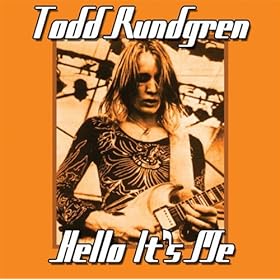
Todd Rundgren, "Hello It's Me"

Hello, it's D*: Please give a warm welcome to my friend Dave*, on whose blog 40 Years Ago Today I guest-blogged last year. He's a close friend and a fellow miner in pop-culture arcana, and here he provides a terrific take on a song that debuted on the charts 35 years ago this week.

_____

10 years ago this fall, That '70s Show debuted. Pop Argot and I were both very curious to see it, to see if the producers had accurately depicted a time we're both very interested in. As it happens, PA couldn't see the first episode, so I gave him my impressions.

"They did a good job," I said, "except the plot centered around the protagonists going to a Todd Rundgren concert."

"Well, that's a good thing," PA answered. "They put some thought into it. They didn't go with the obvious choice like Frampton or KISS."

"Yeah, but ... they were using "Hello, It's Me" as a love song!"

We agreed that was pretty messed up, and looking back now on what became a very successful series, I still wonder what they were thinking - having Jackie claim she and Kelso were making out to the song, or playing it the background as Eric lounged on the Vista cruiser in lovebliss. Though it is a very '70s song, "Hello, It's Me" is not that kind of song. At all.

When I think of the '70s, the first image in my mind's eye is people wearing unattractive clothes during autumn. I know in theory that only one-quarter of the decade occurred during the fall, but for some reason, that's the way I'm predisposed to see it. Partly it's because the decade’s primary colors were all earth tones, the kinds of yellow, orange and brown that dominate fall. But largely it's because I think of the '70s as an autumnal decade. A decade of regrets. A decade of people trying to forget failed dreams. A divorce decade.

The '70s were a divorce decade. The divorce rate began rising the late '60s and then started soaring the early '70s, eventually hitting a double peak in '79 and '81 and declining steadily thereafter. All kinds of people were getting divorced in the '70s: Members of the GI generation who found once the kids were gone, there was no reason to stay married; Silents who discovered the social context for the marriages no longer existed; Baby Boomers who had gotten together during the optimistic '60s and found their love disappeared with that spirit of that era.

"Hello, It's Me" is a divorce song. That's why it I found it baffling the writers of That '70s Show used it as a love song. For me, it's more than a standard breakup song. It's about that sense of giving up, of losing the past, about something that is being given up at great cost.

When I hear the song, I see a story. It's sometime around 1972. They were a Movement couple. They marched together, worked together and eventually fell in love.

But then the Movement ended and they began drifting apart. One of them tried a career; the other didn't support it. One of them got into TM or est; the other thought it was bullshit. Money and sex became faultlines, as they often do. The house began to fill up with the frost that comes from realizing your least favorite person in the world is the one on the other side of your bed.

After one more screaming fight, he stormed out and took a long walk through the grey-cotton November afternoon. On the way, he had a moment of clarity. He knew what he had to do. It would be hard, but at least they wouldn't have to hate each other anymore.

He went back to the house and told her.

It's important to me
That you know you are free


Then he packed a suitcase and left, shuffling his feet through banks of fallen leaves.

Monday, September 29, 2008

Jim Croce, "I Got a Name"

There's a temptation to look for date hooks when posting almost-daily blog entries. But I don't want this blog to be "On This Day in Music History." Still, many anniversaries deserve to be noted, and I missed one a little over a week ago: September 20 marked the 35th anniversary of the death of the wonderful Jim Croce.

Croce was as unlikely as pop stars get: with a nose and a mustache his face could barely contain, and a stage outfit of worn dungarees, he looked more like someone who'd spent the day painting houses than someone who was sharing the charts with Bowie and McCartney and Stevie Wonder and Cher. And that's one of the glories of the early '70s in pop and rock: you really could rise on the quality of the songs. And Croce, in his short chart career, had a magnificent quality to his.

"Bad, Bad Leroy Brown" is one of the very first songs I ever remember hearing. (Helps that its chorus mentioned a junkyard, at a time when I owned a board game called Junkyard and was watching a lot of Fat Albert and Sanford & Son - junkyards were a frequent theme in the mid '70s in my world.) It's a wonder of storytelling, as are its related "You Don't Mess Around With Jim," and on the other side of the coin, the gentle "Operator" and the seemingly Spanish wind of "Time in a Bottle."

But my favorite was, and is, "I Got a Name," a declaration of independence and identity that has guided me through many a moment of self-doubt. Jim knew the value of keeping one's dreams at the front of one's heart, even if it means walking a path alone while trying to actualize those dreams. He went there proud, and succeeded fabulously, even if he tragically did not get to reap the rewards of his work, his songcraft. Life did not pass him by, and I hope we can all say the same for ourselves.

Monday, September 22, 2008

Bobby Goldsboro, "Summer (The First Time)"

As summer draws to a close this afternoon, I figured I'd offer one last tribute to the season. Bobby Goldsboro, the man behind such dreck as "See the Funny Little Clown" and "Honey," had his final Top 40 hit with a winsome look back at the loss of his virginity 10 years prior. I'm generally weirded out by deflowering songs, but this one was actually the best of his efforts. Which isn't saying all that much, but hey.

"Summer (The First Time)" was the first MILF anthem - "She was 31, I was 17" - and a far, far less icky one that Boomer Castleman's Elektra-complexioned "Judy Mae." Now, Millie Jackson did a far superior version of this song as the closer to her concept album Caught Up (a topic for another day, as she and the album deserve their own space), but I couldn't find a clip to post here. So we'll make do with Goldsboro's original, a perfectly competent story song with fewer forced rhymes than his usual and an arragement that nicely suggests the first hint of autumn winds taking the stickiness out of tense, anticipatory summer air.

Tuesday, July 29, 2008

Paul Simon, "American Tune"

"Many is the time I've been mistaken
And many times confused.
Yes, and I've often felt forsaken
And certainly misused.
But I'm all right, I'm all right
I'm just weary to my bones.
Still you don't expect to be bright and bon vivant
So far away from home."

For the days when nothing feels at ease, here are rhymin' Simon and his old partner Art Garfunkel on his "American Tune", guiding us as we wonder what's gone wrong.

Wednesday, June 25, 2008

Lighthouse, "Pretty Lady"

Yesterday I linked to a YouTube clip (Stories' cover of "Mamy Blue") that had been uploaded by a guy who calls himself Music Mike. In his uploading of lesser-known clips with history-lesson introductions, he seems to have styled himself after the classic oldies DJs of the rock era — the Dick Bartley and Cousin Brucie and Casey Kasem types — which I think is a genius idea. For lack of a better term, I call people like Music Mike YouJays; they're seeking to function as tastemakers in their spheres of influence, and we need more of those now, with so few radio DJs anymore serving as tastemakers.

So I owe Music Mike and his "Flashback Favorites" series a debt of gratitude: he introduced me last fall to not only Stories' version of "Mamy Blue" but also a song that has rapidly barreled into my all-time Top 10.

And I do not take my all-time lists lightly.

"Pretty Lady" was an almost-hit for a Canadian jazz-rock ensemble called Lighthouse, who scored two decent-sized hits in the early '70s: "Sunny Days" and "One Fine Morning," the latter of which is also a major fave of mine. The songs share driving rock beats, engaging horn charts with clever fills, gruff vocals, and delightfully pristine and intricate productions that allow each member of the multitude to shine. I've always adored brass rock, that melodic punch of trumpet with a steady beat behind it, and "Pretty Lady," with its gorgeously ornate arrangement and soaring backing vocals, is really the greatest brass-rock song ever recorded. It unconscionably petered out at #53 on the charts in 1973; I've been thinking it shoulda been an easy Top 10.

PS: I find it kind of fascinating that a person as obscure as Skip Prokop (the band's drummer) should have written three of my absolute favorite songs: those aforementioned Lighthouse tracks, and Three Dog Night's "I'd Be So Happy," a ballad of regret that actually bookends kind of nicely with "Mamy Blue."